
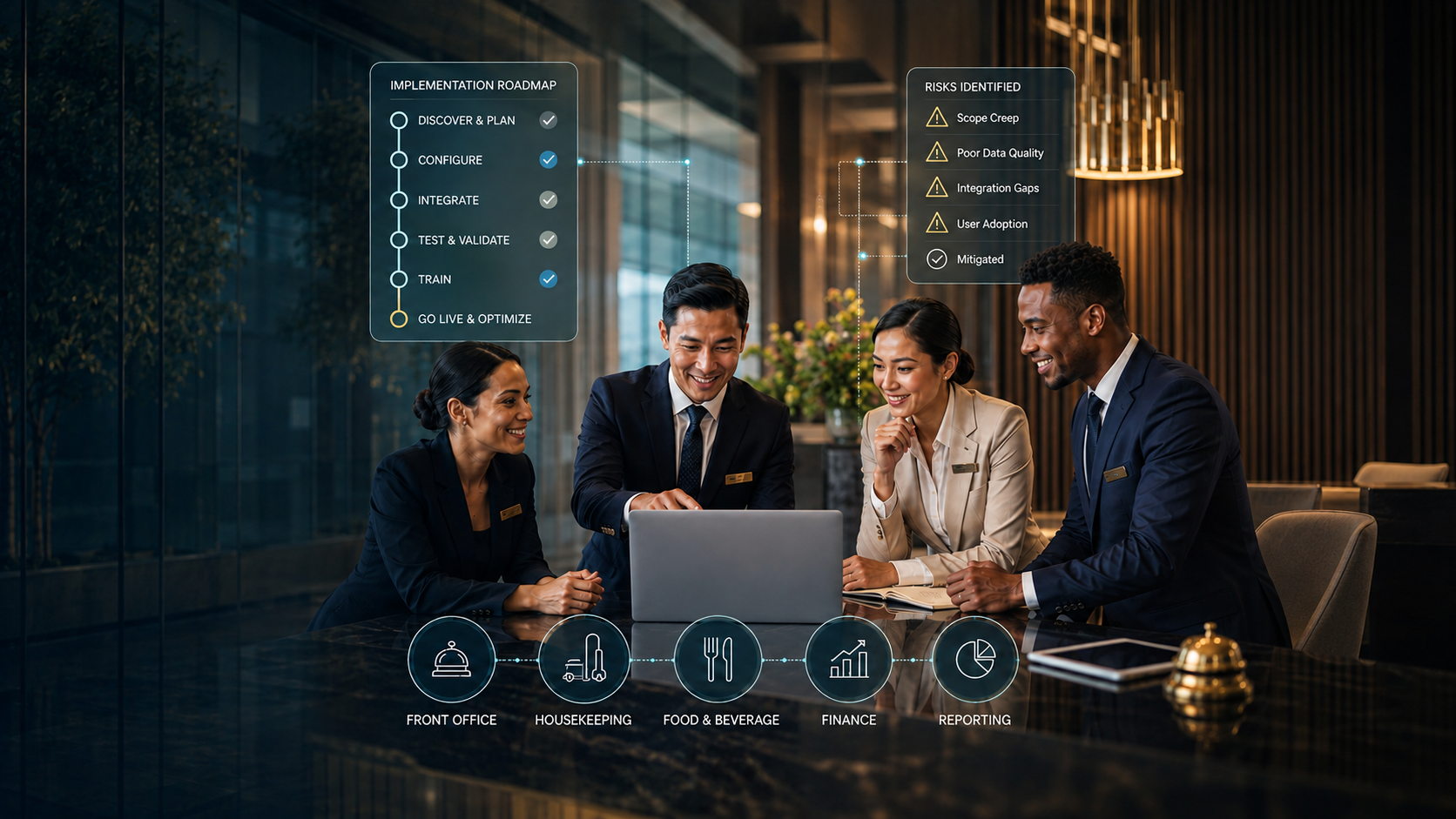
10 Common Hospitality & Golf Software Implementation Mistakes (and How to Avoid Them)
20th August 2026
Tharene Van der Spuy
Implementing new hospitality software is one of the most important technology investments a hotel, lodge, game reserve, or hospitality group can make. The right hospitality ERP software streamlines operations, improves guest experiences, increases efficiency, and provides valuable business insights.
Unfortunately, many hospitality businesses encounter avoidable challenges during implementation. Delays, budget overruns, duplicate data, and frustrated staff often stem not from the software itself, but from common implementation mistakes.
At CiMSO, we’ve successfully implemented fully integrated hospitality management solutions across hotels, lodges, restaurants, spas, golf estates, retail outlets, and multi-property groups. Based on our experience, here are the ten most common mistakes and how to avoid them.
1. Choosing Software That Isn’t Fully Integrated
One of the biggest mistakes is selecting multiple standalone systems for different departments.
For example:
- One system for reservations
- Another for POS
- Separate accounting software
- Independent spa software
- Different stock management software
While each system may perform its own function well, the lack of integration creates duplicate work, inconsistent data, and manual processes.
How to avoid it
Choose a fully integrated hospitality ERP system like CiMSO, where reservations, front office, housekeeping, finance, stock control, procurement, point of sale, spa, golf, retail, maintenance, CRM, and reporting all operate within a single database.
This means:
- One source of truth
- Real-time information
- No duplicate capturing
- Improved reporting
- Better operational efficiency
2. Underestimating Data Migration
Your new system is only as good as the data you move into it.
Many businesses underestimate the time required to clean guest records, rates, suppliers, inventory, financial information, and historical reservations.
Poor-quality data leads to:
- Duplicate guest profiles
- Incorrect financial balances
- Pricing errors
- Inventory discrepancies
- Reporting inaccuracies
How to avoid it
Start cleaning your data long before implementation begins.
Work closely with your implementation partner to validate information before importing it into your hospitality software.
3. Not Defining Clear Business Processes
Technology cannot fix broken processes.
If different departments all follow different procedures, implementing software without standardising workflows often creates confusion.
Examples include:
- Reservation procedures
- Stock ordering
- Night audit processes
- Housekeeping workflows
- Purchasing approvals
How to avoid it
Document your operational processes before implementation.
A good implementation partner will help identify opportunities to simplify and standardise workflows while configuring the software around your operational requirements.
4. Insufficient Staff Training
Even the best hotel management software can fail if staff are not confident using it.
Many organisations only train a few key users or rush through training to save time.
The result?
- User frustration
- Incorrect transactions
- Reduced productivity
- Resistance to change
How to avoid it
Invest in comprehensive training for every department.
CiMSO provides role-based training so that reception, finance, housekeeping, reservations, management, and operational staff all receive training relevant to their daily responsibilities.
5. Ignoring Change Management
People naturally resist change—especially when they’ve been using the same software for years.
Without proper communication, staff may view a new system as a disruption instead of an improvement.
How to avoid it
Keep employees informed throughout the project.
Explain:
- Why the new system is being introduced
- The benefits to their daily work
- Project timelines
- Expected changes
- Available support
When employees understand the “why,” adoption becomes significantly easier.
6. Focusing Only on Today’s Needs
Many hospitality businesses purchase software that solves today’s problems but doesn’t support future growth.
As the business expands, they discover the system cannot accommodate:
- Multiple properties
- Additional restaurants
- Spas
- Golf estates
- Retail outlets
- Increased transaction volumes
How to avoid it
Choose scalable hospitality software.
CiMSO is designed to grow with your business, whether you’re managing a single boutique lodge or a large multi-property hospitality group.
7. Overlooking Reporting Requirements
Managers often realise after implementation that the reports they need are unavailable—or require extensive manual work.
Decision-makers need accurate information to monitor:
- Occupancy
- Revenue
- ADR
- RevPAR
- Food costs
- Stock variances
- Departmental profitability
- Cash flow
- Operational performance
How to avoid it
Identify your reporting requirements before implementation.
An integrated ERP platform like CiMSO provides real-time operational and financial reporting across every department, enabling faster and more informed business decisions.
8. Neglecting Infrastructure Requirements
Even excellent software cannot compensate for poor infrastructure.
Common issues include:
- Slow networks
- Unstable internet connections
- Incorrect server specifications
- Multiple disconnected LANs
- Outdated hardware
These problems affect system performance and user experience.
How to avoid it
Conduct a full infrastructure assessment before implementation.
Ensuring your network, servers, workstations, and connectivity meet the required specifications creates a stable foundation for your new hospitality software.
9. Treating Implementation as an IT Project
Hospitality software implementation isn’t just an IT exercise.
It affects every department:
- Front Office
- Reservations
- Finance
- Housekeeping
- Food & Beverage
- Procurement
- Maintenance
- Spa
- Retail
- Management
How to avoid it
Create a cross-functional implementation team with representatives from every department.
This ensures the system is configured to support real operational requirements—not just technical ones.
10. Choosing Price Over Long-Term Value
Low-cost software often becomes expensive over time.
Businesses may encounter:
- Manual processes
- Limited functionality
- Poor reporting
- Expensive upgrades
The true cost of ownership can be much higher than expected.
How to avoid it
Evaluate software based on long-term business value rather than purchase price alone.
A fully integrated ERP solution reduces ongoing operational costs, improves productivity, minimises duplicate work, and provides the visibility needed to make better business decisions.
Why Hospitality Businesses Choose CiMSO
Successful hospitality software implementation is about more than installing software, it’s about building a platform that supports your business for years to come.
CiMSO is a fully integrated hospitality ERP solution designed specifically for the hospitality industry. By combining reservations, front office, point of sale, finance, stock management, procurement, housekeeping, maintenance, spa, golf, retail, CRM, and reporting into one centralised system, businesses eliminate silos and gain complete visibility across their operations.
Whether you’re operating a boutique lodge, luxury hotel, safari reserve, resort, or multi-property hospitality group, CiMSO helps simplify operations, improve efficiency, and deliver exceptional guest experiences.
Ready to Modernise Your Hospitality Operations?
If you’re planning a hospitality software implementation or looking to replace disconnected systems with a fully integrated ERP solution, CiMSO can help.
Our experienced operations team works closely with every client to ensure a smooth transition, comprehensive training, and long-term success.
Contact CiMSO today to discover how an integrated hospitality ERP can transform your business.

Sep. 22, 2026
The Most Interesting Hospitality Innovations Shaping Africa in 2026

Sep. 21, 2026
Africa’s Golf Tourism Opportunity: Is Your Club Ready for the International Golfer?

Sep. 18, 2026
From Gift to Green Fee: Why Golf Clubs Need Better Voucher Management

Sep. 18, 2026
Your Voice Shapes the Conversation: Turning Your Feedback Into Solutions

Aug. 28, 2026
Multi-Currency Hospitality Management in Southern Africa

Aug. 24, 2026
Sustainable Procurement: Can Your Property Track What It Buys?
Aug. 20, 2026
10 Common Hospitality & Golf Software Implementation Mistakes (and How to Avoid Them)
Aug. 20, 2026
Implementing CiMSO Successfully: Why Project Management Is Critical

Jul. 24, 2026
Streamlining Activities, Scheduling, and Guest Experiences

Jul. 24, 2026
Taking Control of Inventory Management

Jul. 24, 2026
From Players to Members: Creating a More Engaging Golf Club Experience

Jul. 24, 2026