
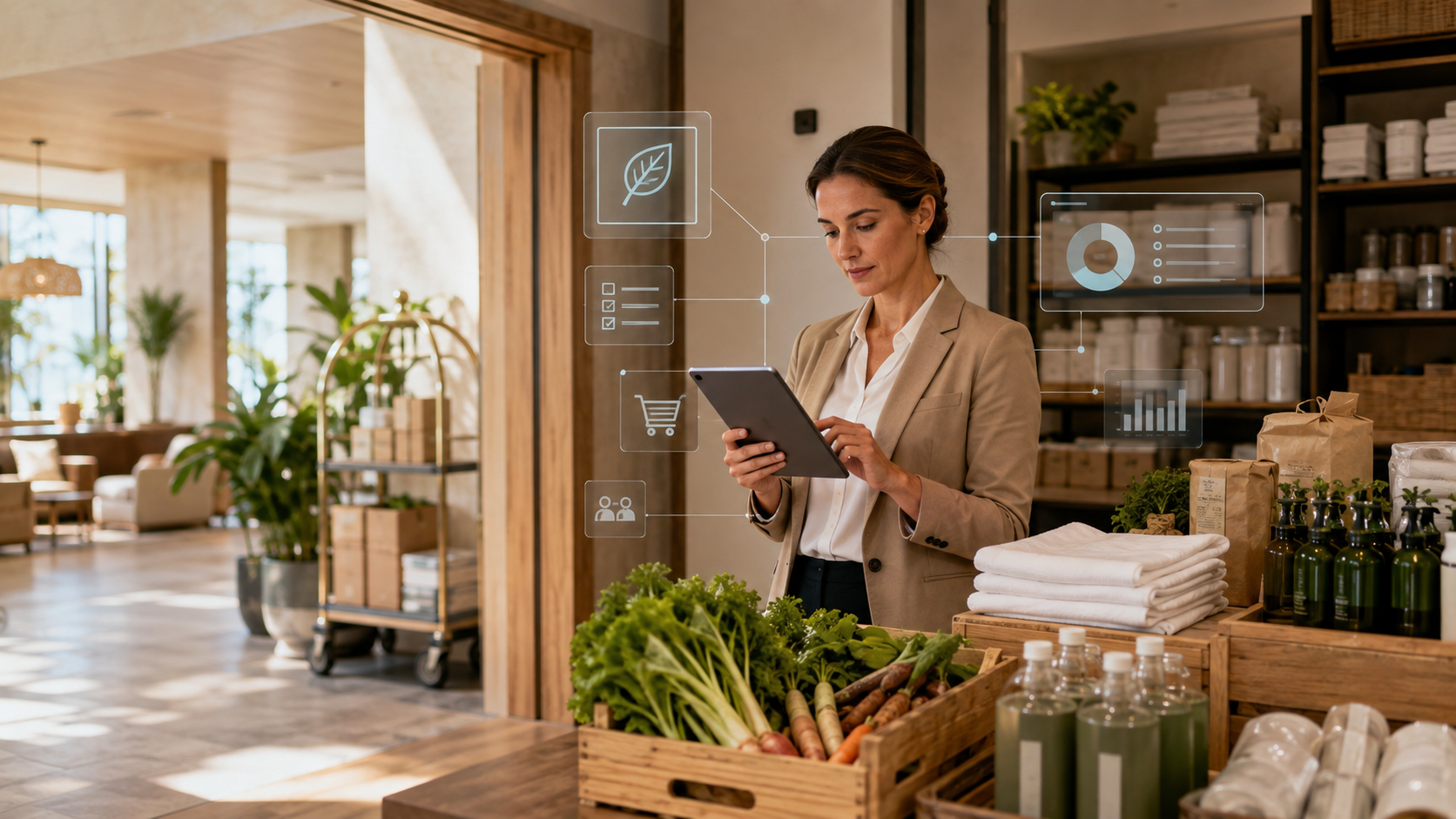
Sustainable Procurement: Can Your Property Track What It Buys?
24th August 2026
Tharene Van der Spuy
Sustainability in hospitality is no longer limited to asking guests to reuse towels or installing energy-efficient lighting. Properties are increasingly examining the environmental, social and financial impact of the products they purchase.
Every item a hospitality business buys, from food and guest amenities to cleaning products, linen, and maintenance materials, contributes to its sustainability footprint.
Before a property can improve its purchasing decisions, however, it must answer an important question:
Do you know exactly what your property buys, where it comes from and how much of it is used or wasted?
What Is Sustainable Procurement?
Sustainable procurement means purchasing products and services while considering more than price alone.
It may take into account:
- Where a product was produced
- How far it travelled
- Whether the supplier operates responsibly
- The amount of packaging used
- Whether the product can be reused or recycled
- The product’s expected lifespan
- Whether local communities benefit
- How much of the product is ultimately wasted
Sustainable procurement does not necessarily mean choosing the most expensive environmentally friendly option. It means balancing operational requirements, cost, quality and environmental or social impact.
Why Procurement Matters in Hospitality
Hotels, lodges, resorts and clubs purchase large volumes of goods across several departments, including:
- Food and beverages
- Guest amenities
- Linen and towels
- Cleaning chemicals
- Packaging and disposable products
- Furniture and equipment
- Maintenance materials
- Spa and retail products
These purchasing decisions affect operating costs, waste levels, local economic development and the sustainability of the property’s supply chain.
However, if procurement information is scattered across spreadsheets, emails and departmental systems, management may struggle to determine what is being purchased and whether procurement goals are being achieved.
Sustainable procurement therefore starts with visibility.
Can You See What Your Property Is Buying?
Many hospitality businesses know how much they spend overall but have limited visibility into purchasing across individual departments.
This makes important questions difficult to answer:
- How much do we spend with local suppliers?
- Which products use excessive packaging?
- Are departments buying the same products at different prices?
- Which items are frequently wasted or written off?
- Are teams ordering more stock than the property uses?
- Which suppliers consistently meet our requirements?
- Are sustainable alternatives providing value?
If this information cannot be accessed easily, it becomes difficult to measure progress or make informed purchasing decisions.
The Cost of Disconnected Purchasing Systems
When purchasing, stock control, and accounting operate separately, management sees only part of the procurement picture.
A purchase order may be created manually, the goods received in another system, and the supplier invoice captured separately by finance. Stock usage may then be recorded on a spreadsheet—or not recorded at all.
This can lead to:
- Duplicate orders
- Inconsistent product descriptions
- Poor control over supplier pricing
- Excessive stockholding
- Increased waste
- Time-consuming invoice reconciliation
- Limited sustainability reporting
It also prevents management from connecting what was purchased with what was used, sold, wasted or written off.
How Integrated ERP Software Supports Sustainable Procurement
A fully integrated Enterprise Resource Planning (ERP) solution connects purchasing with supplier management, stock control, operations, accounting and reporting.
It provides visibility across the purchasing lifecycle:
- A department identifies a requirement.
- A purchase order is created.
- Goods are received and checked.
- Stock quantities and values are updated.
- The supplier invoice is processed.
- Products are issued, transferred, sold or consumed.
- Management reviews purchasing, usage and financial performance.
This connected process gives management a clearer understanding of where money and resources are going.
Build a Reliable Supplier Database
A central supplier database can help a property maintain information such as:
- Supplier contact details
- Products supplied
- Agreed prices
- Payment terms
- Delivery performance
- Supplier location
- Sustainability certifications
- Packaging commitments
- Contract and review dates
This information helps purchasing teams compare suppliers and make decisions based on more than price alone.
It also allows hospitality businesses to turn broad commitments—such as supporting local suppliers—into measurable results.
Connect Purchasing With Stock Control
Sustainable procurement is not only about choosing responsible suppliers. It is also about buying the right quantities.
Ordering too much ties up cash and increases the risk of expiry, damage and waste. Ordering too little may interrupt service and lead to expensive emergency purchases.
Integrated stock control helps properties monitor:
- Current stock quantities
- Consumption patterns
- Minimum and maximum stock levels
- Slow-moving items
- Stock variances
- Purchasing history
- Actual product costs
Purchasing teams can then make decisions based on real demand rather than assumptions.
Reduce Food Waste With Better Information
Food and beverage procurement offers one of the clearest opportunities to connect sustainability with cost control.
Food may be wasted because of over-ordering, poor stock rotation, oversized portions, buffet overproduction or products expiring before use.
By comparing purchasing, stock and sales information, management can identify patterns and adjust future orders or production quantities.
Reducing food waste therefore begins before food reaches the kitchen. It starts with accurate purchasing and consumption information.
Look Beyond the Lowest Price
The cheapest product is not always the most sustainable or cost-effective choice.
A less expensive item may have a shorter lifespan, require frequent replacement, use excessive packaging or generate more waste.
Sustainable procurement considers the total cost of ownership. A higher-quality product that lasts twice as long may provide better value than a cheaper alternative that must be replaced regularly.
Reliable purchasing and usage data helps management compare these options accurately.
Questions to Ask About Your Procurement Process
Consider the following:
- Do we have a central list of approved suppliers?
- Can we see what each department or property purchases?
- Can we compare supplier prices?
- Do purchase orders, goods received, and invoices connect?
- Can we measure spending with local suppliers?
- Can we identify slow-moving, damaged or expired stock?
- Can we compare purchases with consumption and sales?
- Can we produce reliable sustainability information without manually combining spreadsheets?
If most answers are “no,” the property may require stronger processes and better-integrated technology.
How CiMSO Supports Better Procurement
CiMSO’s fully integrated hospitality ERP software connects purchasing, supplier management, stock control, point of sale, operations, accounting and reporting.
This helps hospitality businesses:
- Strengthen purchasing control
- Maintain structured supplier records
- Compare costs and consumption
- Monitor stock movement
- Reduce unnecessary purchasing
- Identify waste and stock variances
- Improve financial reporting
- Support measurable procurement goals
Technology alone does not make procurement sustainable. It provides the information and control management needs to make more responsible decisions.
Sustainable Procurement Starts With Visibility
A property cannot improve what it cannot see.
Sustainable procurement begins with understanding what the business buys, who it buys from, how products are used and what is wasted.
When purchasing information is scattered across systems, sustainability remains difficult to measure. When procurement, stock, operations and finance are connected, management can turn sustainability goals into practical action.
The question is not only whether your property buys sustainable products.
Can your property prove it?
Improve Procurement Visibility With CiMSO
Discover how CiMSO can connect purchasing, suppliers, stock control, operations and financial reporting across your hospitality business.
Book a personalised demonstration.
Telephone: +27 21 852 2388
Email: [email protected]

Sep. 22, 2026
The Most Interesting Hospitality Innovations Shaping Africa in 2026

Sep. 21, 2026
Africa’s Golf Tourism Opportunity: Is Your Club Ready for the International Golfer?
Sep. 18, 2026
From Gift to Green Fee: Why Golf Clubs Need Better Voucher Management

Sep. 18, 2026
Your Voice Shapes the Conversation: Turning Your Feedback Into Solutions

Aug. 28, 2026
Multi-Currency Hospitality Management in Southern Africa
Aug. 24, 2026
Sustainable Procurement: Can Your Property Track What It Buys?
Aug. 20, 2026
10 Common Hospitality & Golf Software Implementation Mistakes (and How to Avoid Them)
Aug. 20, 2026
Implementing CiMSO Successfully: Why Project Management Is Critical

Jul. 24, 2026
Streamlining Activities, Scheduling, and Guest Experiences

Jul. 24, 2026
Taking Control of Inventory Management

Jul. 24, 2026
From Players to Members: Creating a More Engaging Golf Club Experience

Jul. 24, 2026