
When Sustainability Becomes Smart Golf Course Management: Lessons from Operation Pollinator
17th October 2026
Tharene Van der Spuy
A golf course can be many things at once.
It is a place to play the game, a carefully managed sporting environment, a workplace for greenkeeping teams and, increasingly, a landscape with an important role to play in supporting biodiversity.
A recent article from the Asian Golf Industry Federation (AGIF) provides a fascinating example of what can happen when these different roles are considered together.
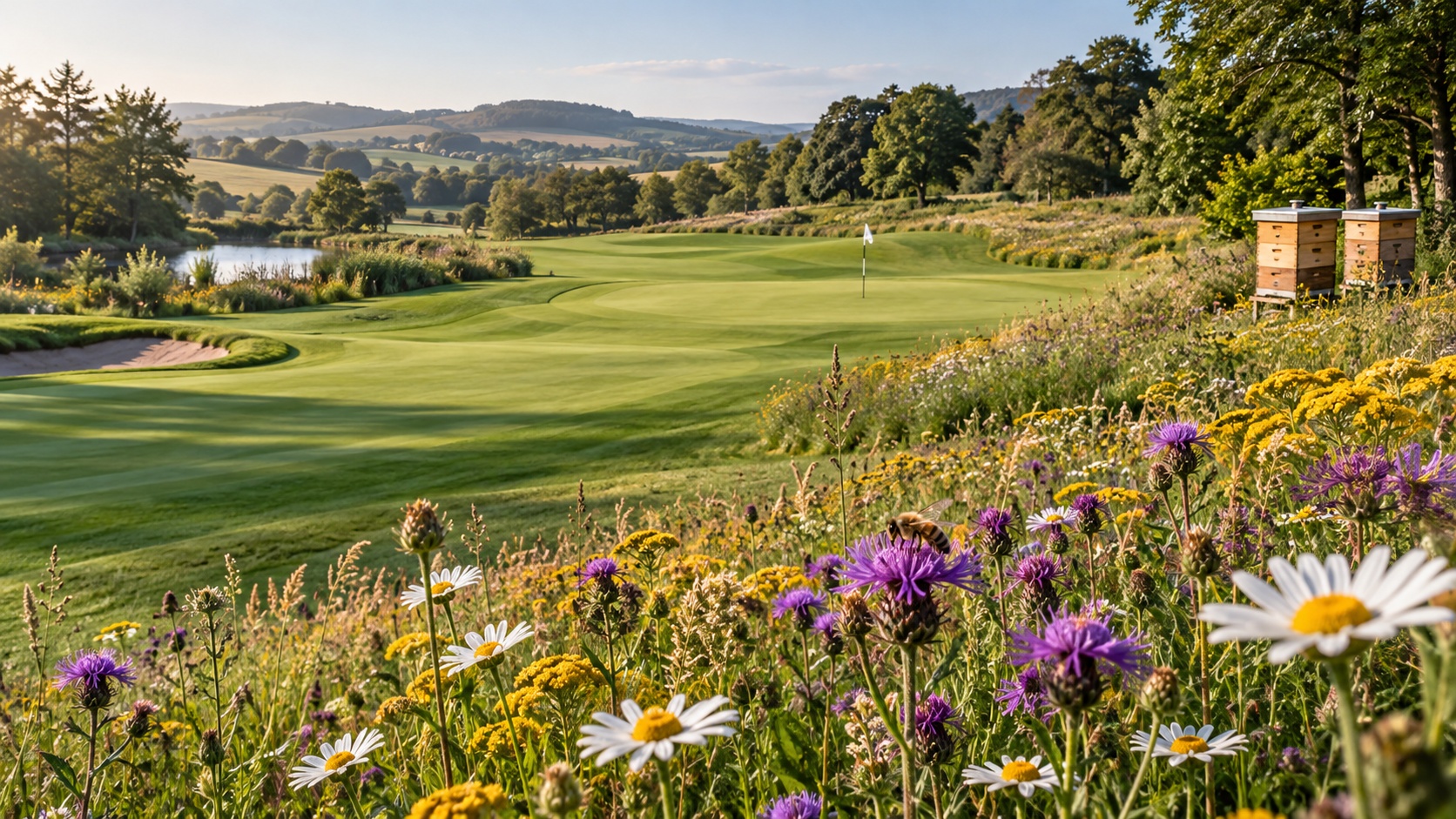
The article, “Spotlight on Operation Pollinator Project,” highlights the work taking place at Goring & Streatley Golf Club in the UK, where the greenkeeping team has transformed areas of rough into wildflower habitat designed to support pollinating insects.
The project has created approximately 7.5 hectares of habitat, while also producing an unexpected commercial opportunity through a relationship with a local beekeeper. According to the AGIF article, honey produced from the site has generated more than £20,000 in revenue for the club, with the proceeds being reinvested into further biodiversity projects.
But perhaps the most interesting part of the story for golf club managers is not the honey.
It is the idea that environmental responsibility and operational efficiency do not necessarily have to compete with one another.
Read the full AGIF article: “Spotlight on Operation Pollinator Project”
Looking at the Course Beyond the Fairways
Golf course management is built around precision.
Greens need to perform. Fairways need to be maintained. Tees, bunkers, surrounds and other playing areas all have specific requirements.
But a golf property contains much more than its primary playing surfaces.
There are areas between holes, course boundaries, roughs and other spaces that may have a different role to play. The Goring & Streatley example demonstrates how some of these areas can potentially be managed with biodiversity in mind rather than being maintained to the same intensity as areas directly involved in play.
According to the AGIF feature, the club’s approach has involved allowing selected areas to develop into wildflower-rich habitat. This has created an environment suitable for pollinating insects while reducing the level of maintenance required in those areas.
That creates an interesting management question for golf clubs everywhere:
Are we maintaining every part of our property because it needs to be maintained that way — or simply because that is how we have always done it?
The Greenkeeper’s Role Is Changing
The story also highlights something that is sometimes overlooked in discussions about sustainable golf: the expertise of the greenkeeping team.
Environmental initiatives on golf courses are not simply about leaving areas to grow. They require planning, knowledge and ongoing management.
In the AGIF article, Goring & Streatley’s Deputy Course Manager Melissa Winkworth describes how an interest in ecology helped initiate the club’s biodiversity projects, while Course Manager Matt Aplin discusses plans to build on the work already undertaken.
This reflects a broader change in the role of course-management professionals.
Modern greenkeepers are not only responsible for producing excellent playing surfaces. They are increasingly involved in questions around water, resource management, biodiversity, environmental impact and the long-term health of the land they manage.
And that means clubs need to give their teams the tools and information required to make informed decisions.
When Doing Things Differently Creates New Value
The Goring & Streatley project is particularly interesting because its benefits extend beyond biodiversity.
The relationship with a local beekeeper has created a product and revenue stream that did not previously exist. The AGIF article reports that the resulting honey sales have generated more than £20,000 for the club, with that money being directed back into biodiversity projects.
The club is also looking at future opportunities, including an orchard near the beehives, with fruit intended for use in the clubhouse.
It is a useful illustration of a broader principle:
Sustainability does not always have to be an expense. Sometimes, changing the way a property is managed can create new opportunities.
Those opportunities will obviously look different from club to club.
For one property, it might be biodiversity.
For another, it might be water conservation.
For another, it could involve food production, renewable energy, waste reduction or more efficient use of resources.
The important part is identifying where environmental responsibility and operational objectives can support one another.
Sustainability Requires Good Information
This is where the conversation becomes particularly relevant to club management.
It is easy to talk about sustainability in broad terms.
It is much harder to manage it effectively.
A club needs to understand what resources it is using, what those resources cost and where there are opportunities to improve efficiency.
How much is being spent on course-related purchases?
Which departments are responsible for particular costs?
How are purchasing patterns changing?
Where could resources potentially be reduced or redirected?
What impact is a new initiative having on the club’s finances?
These are not purely environmental questions.
They are management questions.
And management questions require reliable information.
Bringing Sustainability into the Wider Club Operation
A golf club is a complex business. The course is at its heart, but it operates alongside a clubhouse, food and beverage operations, events, membership administration, finance, procurement, stock management and numerous other functions.
An environmental initiative may touch several of these areas at once.
For example, a change in course-management practices could influence purchasing requirements. A food-growing initiative could eventually connect with the clubhouse kitchen. A reduction in maintenance requirements could influence labour allocation. A biodiversity project could become part of the club’s communication and member-engagement strategy.
The more connected the initiative becomes, the more important it is for management to have a clear view of the information behind it.
This is one of the advantages of an integrated approach to club management.
When financial, operational, stock and procurement information can be viewed together, management teams have a stronger foundation for understanding how decisions in one area can affect another.
Sustainability Can Become Part of the Member Experience
There is also an opportunity to bring members into the story.
Golfers increasingly experience the course as more than a collection of holes. The landscape, scenery and natural environment are part of the experience.
A club can therefore turn environmental projects into opportunities for engagement.
Members can learn about biodiversity initiatives taking place on the property. Clubs can share progress through newsletters and social media. Signage can explain why particular areas are being managed differently.
Projects can also become educational opportunities for junior golfers and the wider community.
The result is that sustainability becomes visible.
Instead of being something that happens quietly behind the scenes, it becomes part of what makes the club distinctive.
Operation Pollinator Shows What Is Possible
The AGIF’s feature on Operation Pollinator is ultimately a story about looking at a familiar environment differently.
At Goring & Streatley, areas that might traditionally have been viewed simply as rough have become part of a broader biodiversity strategy. The project has supported pollinating insects, created opportunities for honey production and helped fund further environmental work, while the club’s course-management team has been able to reconsider where intensive maintenance is most valuable.
Operation Pollinator itself was established to address declining natural habitats and pollinator populations and, according to the AGIF article, is active across 41 countries.
That does not mean every golf club should attempt to replicate Goring & Streatley’s approach.
Instead, it provides something arguably more useful:
An example of what can happen when clubs question established practices and look for opportunities to make their land work harder — environmentally, operationally and commercially.
The Future of Golf Course Management
The future of golf is not simply about producing immaculate fairways and greens.
It is also about understanding the wider environment in which those playing surfaces exist.
As clubs face increasing pressure to manage resources responsibly, demonstrate environmental awareness and operate efficiently, sustainability will become increasingly connected to everyday management decisions.
And those decisions need information behind them.
At CiMSO, we believe technology has an important role to play in giving golf clubs greater visibility across the operations that support the member experience — from financial management and procurement to stock and day-to-day club operations.
Because a smarter golf club is not simply one that has more technology.
It is one that has better information to make better-informed decisions.
The Operation Pollinator example highlighted by AGIF shows what can happen when golf clubs look beyond traditional approaches to course management.
Perhaps the next opportunity is to ask:
What could your club achieve if you looked at your course a little differently?
Oct. 17, 2026
A Taste to Take Home
Oct. 17, 2026
When Sustainability Becomes Smart Golf Course Management: Lessons from Operation Pollinator

Sep. 22, 2026
The Most Interesting Hospitality Innovations Shaping Africa in 2026

Sep. 21, 2026
Africa’s Golf Tourism Opportunity: Is Your Club Ready for the International Golfer?

Sep. 18, 2026
From Gift to Green Fee: Why Golf Clubs Need Better Voucher Management

Sep. 18, 2026
Your Voice Shapes the Conversation: Turning Your Feedback Into Solutions

Aug. 28, 2026
Multi-Currency Hospitality & Golf Management in Southern Africa

Aug. 24, 2026
Sustainable Procurement: Can Your Property Track What It Buys?

Aug. 20, 2026
10 Common Hospitality & Golf Software Implementation Mistakes (and How to Avoid Them)

Aug. 20, 2026
Implementing CiMSO Successfully: Why Project Management Is Critical

Jul. 24, 2026
Streamlining Activities, Scheduling, and Guest Experiences

Jul. 24, 2026